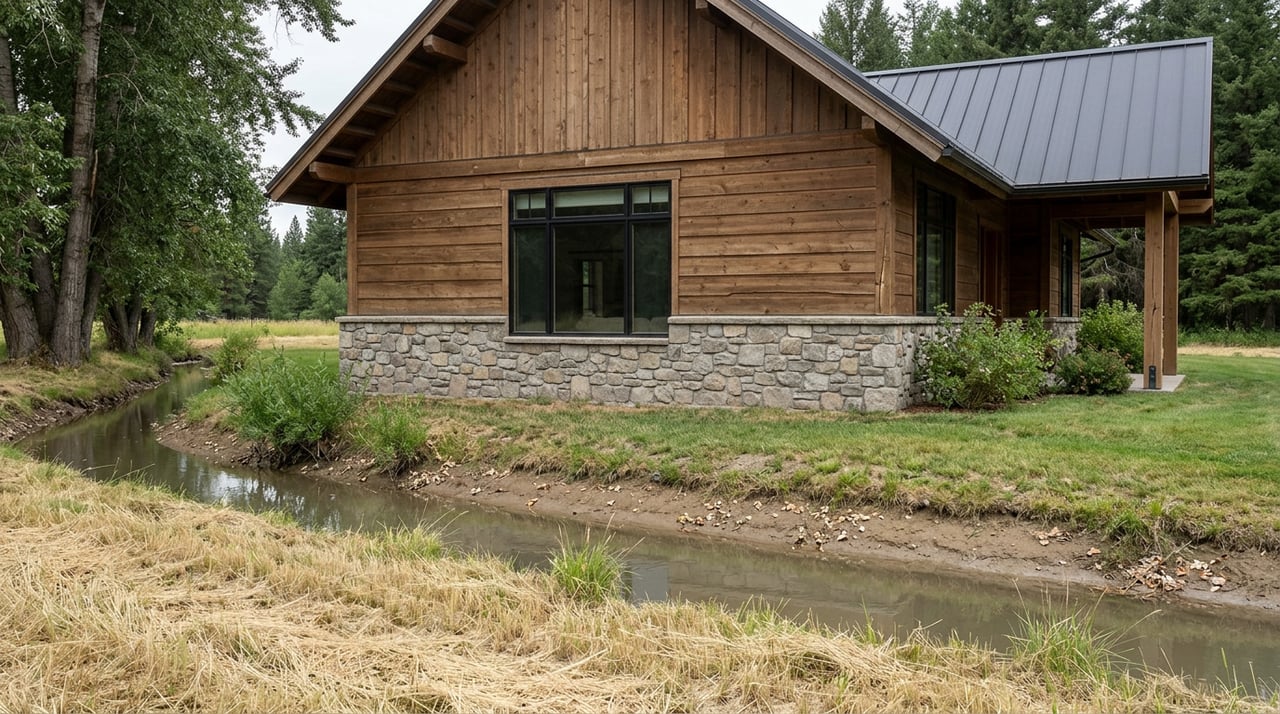
The listing said the twenty acres off Highway 89 came with water rights, and the buyer took that at face value. It's the phrase every acreage listing in Park County uses, tucked between the irrigated hay meadow and the Absaroka views, and for decades it functioned as a green light. Water rights meant water. Full stop.
That shorthand still gets repeated on listing sheets in 2026, but it settles less than it used to. Montana's underlying water law hasn't changed. What changed, as of January 1 this year, is the process that decides whether a right on paper becomes water at your tap, and that process now runs on a clock that starts before you ever turn on the pump.
The doctrine is old. The paperwork just got new teeth.
Montana still runs on prior appropriation: first in time, first in right. Whoever put water to beneficial use earliest holds the senior claim, and in a dry year that priority date is what decides who gets curtailed and who doesn't. None of that is new, and none of it is unique to Paradise Valley. What's new is how the state now handles the most common way rural buyers here actually get water: the exempt well.
An exempt well is the standard fix for a single home on acreage, a groundwater source pumping 35 gallons per minute or less and no more than 10 acre-feet a year, which covers nearly every domestic and stock well in the valley. For fifty years, the deal was simple: drill first, file the paperwork after. That deal ended on January 1, 2026.
The two-step gate that opened this year
Under House Bill 681, passed by the 2025 Legislature and now in effect, anyone developing a new exempt well has to file a Notice of Intent to Appropriate Groundwater, Form 602I, with the Department of Natural Resources and Conservation before putting the water to use, not after. The DNRC's own exempt well guidance confirms the agency now reviews that filing and can authorize or deny it before a shovel goes in the ground. Only once that Notice of Intent is approved can a buyer later file the Notice of Completion, Form 602, once the well is actually in use.
As of 2025 pricing, the Notice of Intent runs roughly $400 and the completion filing roughly $250. Those fees are trivial next to what they buy: the difference between owning a working well and owning a hole in the ground the state won't let you use.
Here's the part that catches out-of-state buyers who did this exact process on a previous property in a different state, or who bought Montana land a decade ago and assume the rules haven't moved:
- Before 2026: drill the well, use the water, file the paperwork whenever convenient.
- As of January 1, 2026: file the Notice of Intent first, wait for DNRC authorization, then drill and use the water, then file completion.
- DNRC will not process a Notice of Completion at all unless an authorized Notice of Intent is already on file, with a narrow exception for filings pending before the new year.
For a buyer closing on raw acreage with plans to drill, that sequencing adds a real step to the timeline, not a formality.
Why the ten acre-foot ceiling matters more than your priority date
Here's the mechanism that actually determines whether your Notice of Intent gets approved: the exempt well exception isn't unlimited per well. It's capped at 10 acre-feet a year per source, and Montana law treats multiple wells drawing from the same groundwater source as one combined appropriation if they could reasonably have been developed as a single project. That combined 10 acre-feet gets shared across every well pulling from that source, not granted fresh to each new owner.
This isn't theoretical. In February 2024, a district court ruled in Upper Missouri Waterkeeper v. DNRC, a case known locally as Horse Creek Hills, that the agency couldn't let a four-phase subdivision treat each phase as its own fresh 10-acre-foot allowance. The court said all four phases had to share one combined cap, and that ruling has been reshaping how DNRC evaluates subdivisions and multi-lot parcels statewide ever since.
The stakes widened again in November 2025, when a coalition that included the Montana Farm Bureau Federation, the Association of Gallatin Agricultural Irrigators, and the Clark Fork Coalition sued the state over what they call the exempt well loophole, arguing that roughly 141,000 wells drilled under the exemption since 1973 have accumulated real impacts on senior water rights the permitting system was never built to track. Guy Alsentzer of Upper Missouri Waterkeeper put the underlying argument plainly: there is no free water for sprawl subdivision development in closed Montana river basins.
Park County isn't a bystander to any of this. A Montana Water Court filing from May 2026 shows an active decree proceeding in Basin 43B, the basin covering Park County, with parties still stipulating to dismiss individual claims this year. Statewide adjudication has run since the late 1970s and DNRC only finished examining every timely filed historic claim across all 85 basins in 2025. In plain terms, the basin under your acreage may not be as settled as the seller's paperwork implies.
The valley is growing fast enough to test that ceiling
None of this is happening in a vacuum. As of April 2026, reporting put Park County at roughly 18,000 residents, small in absolute terms but serving as the gateway to Yellowstone's north entrance and a hub for tourists, recreationists, and even concertgoers. Population growth and record tourism are increasing demands on roads and infrastructure across the valley, and that same pressure shows up in fights over resources that have nothing to do with water on the surface but everything to do with it underneath.
In February 2026, more than fifty people packed the Park County community hall, with another fifty online, after commissioners drafted a letter backing an 80-acre gravel pit lease near Emigrant for a contractor with existing Yellowstone road contracts. Erica Lighthiser, co-managing director of the Park County Environmental Council, framed the pushback as bigger than one pit: it is time for a broader conversation in our community about how we have some say over development. By April 2026, commissioners had reversed course and voted 3-0 to oppose the pit, pointing to an existing gravel source already in Paradise Valley that met the county's needs without touching the site near the river.
The gravel fight and the water fight are the same story told twice. More subdivision activity in a growing valley means more wells drawing from the same shared aquifers, which means the combined 10-acre-foot ceiling on any given source gets tested sooner than a buyer evaluating a single 20-acre parcel would expect.
What this changes at your closing table
For a buyer under contract on Paradise Valley acreage in 2026, the due diligence list has a few new lines that didn't matter as much five years ago:
- Ask whether a Notice of Intent has already been filed for the well serving this parcel, and if not, budget the DNRC's review window into your timeline before you count on that water.
- Ask whether the parcel was carved from a larger tract with other lots pulling from the same groundwater source. If so, find out how much of the shared 10 acre-feet those other wells have already claimed.
- Confirm the basin's adjudication status specifically, not the county's in general. Park County's own Basin 43B still has open Water Court matters moving through the system this year.
- Get any claimed water right named explicitly in the purchase agreement rather than assumed. Rights can be severed from land and sold separately, and a title company's standard search doesn't always catch that on its own.
Locally, wells in the Livingston and Paradise Valley area commonly run 100 to 400 feet deep depending on where the parcel sits, and a complete well system, drilling through pump and pressure tank, typically lands somewhere between $10,000 and $30,000. For agricultural ground specifically, the water right attached to a parcel can represent something like a third to half of the property's total value, which is exactly why the difference between a decreed senior right and an unresolved claim isn't a technicality. It's the number that decides what the land is actually worth.
A few questions we hear often
Does a creek or ditch running through a property mean I have the right to use that water? No. Water rights in Montana are separate from land ownership. A creek crossing your acreage doesn't grant you legal use of it unless a specific, documented right exists and transfers with the sale.
What if the well I'm counting on shares a source with wells on neighboring lots? That's the combined appropriation question. DNRC can treat multiple wells on one source as a single 10-acre-foot appropriation, which means your Notice of Intent could be denied if neighboring lots have already claimed the full allowance.
How do I find out if my basin's adjudication is finished? DNRC's Basin Status page tracks every one of Montana's 85 administrative basins individually, and Park County's Basin 43B still has active Water Court matters moving through in 2026, so it's worth checking rather than assuming.
Water is the line item that decides what a piece of Paradise Valley actually is, a home site with a garden or a working hay meadow with senior rights that hold their value in a dry year. Montana Property Brokers works this valley from a ranching background, which means we ask the water questions before you're standing at the closing table wondering why they weren't asked sooner. If you're looking at acreage here, reach out and we'll walk the water rights history with you before you write an offer, and if you'd like a first look at parcels before they hit the open market, ask us about receiving exclusive off-market listings.